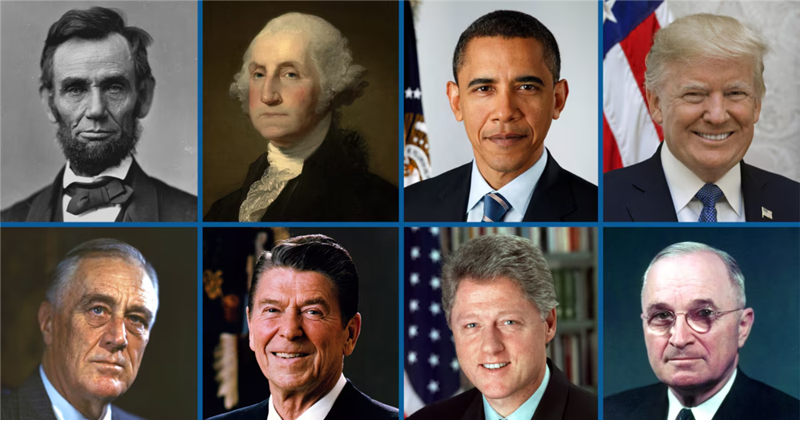

Understanding how the stock market has performed under different U.S. presidents is a topic that Americans — investors, voters, and political observers alike — debate every election cycle. Discussions concerning financial stability, national economic leadership, and the general state of American capitalism all touch on this question:
“What president had the highest stock market?” Short answer- Bill Clinton
On the surface, it seems like the answer should be simple. But the reality is more nuanced. Stock-market performance reflects a complex mix of global economic forces, investor psychology, innovation cycles, interest-rate policy, and only partly presidential decision-making.
One thing is certain, though: some presidents experienced significant market booms, while others encountered global crises, recessions, or crashes.
With U.S. market history, U.S. voter concerns, and U.S. economic context at its core, this piece is written especially for an American audience. It gives a thorough explanation of which president saw the biggest increase in the market, why, and what Americans should know about the connection between stock performance and presidents.
How Americans Typically Measure Stock Market Performance by President
Most U.S. analysts use the S&P 500 as the benchmark for comparing stock performance over a presidential term. Why?
-
It includes 500 of the largest American companies
-
It covers all major industries
-
It’s widely viewed as the most accurate snapshot of overall U.S. market health
Other indices like the Dow Jones can be used, but the Dow only tracks 30 companies, which makes it less comprehensive for comparing presidencies.
When Americans talk about “stock market performance under a president,” they typically mean the cumulative percent change of the S&P 500 from Inauguration Day to the end of the term.
So… Which President Had the Best Stock Market?
Using modern, consistent S&P 500 historical data, the clear winner is:
Bill Clinton — The Highest Stock Market Performance in Modern U.S. History
S&P 500 cumulative growth: roughly +210%
Clinton’s presidency (1993–2001) coincided with:
-
The technology boom
-
Widespread economic expansion
-
Strong consumer confidence
-
Low unemployment
-
Rising corporate profitability
For many Americans, this era is remembered as a time of robust growth — and the numbers show it.
Second Place: Barack Obama — Massive Growth After the Financial Crisis
S&P 500 cumulative growth: about +182% to +189%
Obama took office during the Great Recession. The market was near historic lows and the financial system was in crisis. Over the following years America experienced:
-
Stabilization of the banking sector
-
A long bull market
-
Emergence of major tech giants
-
Near-zero interest rates
-
Increasing investor confidence
By the time Obama left office, the S&P 500 had nearly tripled from its 2009 lows.
For many Americans, this 8-year period represents the longest bull market in history.
Third Place: Donald Trump (First Term)
While his first term saw strong market gains — particularly in 2017 and 2019 — the COVID-19 crash in early 2020 created sharp volatility. Still, the market bounced back quickly, driven by:
-
Corporate tax cuts
-
Deregulation policies
-
Investor optimism
-
Rapid monetary stimulus during the pandemic
Trump’s pre-COVID performance was among the strongest of modern presidents, although final cumulative numbers vary depending on precise start/end dates.
Other Strong Performers in U.S. History
While Clinton and Obama dominate in the modern S&P 500 era, other presidents also saw notable gains:
-
Dwight D. Eisenhower (+129%)
Post-war expansion and strong American industrial growth. -
Ronald Reagan (+117%)
Deregulation, tax cuts, anti-inflation policies, and 1980s economic expansion. -
Calvin Coolidge (1923–1929)
During the Roaring Twenties, the market soared — before collapsing in 1929.
Coolidge’s numbers were enormous, but also unsustainable and followed by the Great Depression.
Table: Stock Market Performance by Key U.S. Presidents
| President | Years | Approx. S&P 500 Return | Key Notes |
|---|---|---|---|
| Bill Clinton | 1993–2001 | +210% | Tech boom, strong economy |
| Barack Obama | 2009–2017 | +182% to +189% | Post-recession recovery |
| Donald Trump (Term 1) | 2017–2021 | Strong but COVID-affected | High volatility |
| Dwight D. Eisenhower | 1953–1961 | +129% | Post-war boom |
| Ronald Reagan | 1981–1989 | +117% | 1980s expansion |
| Calvin Coolidge | 1923–1929 | Very high (pre-Depression) | Boom before 1929 collapse |
What Americans Should Understand: Presidents Don’t Control the Market
Even though Americans often debate which president was “good for the stock market,” the reality is more complicated.
Presidents influence policy — but not everything else
The market responds to:
-
Federal Reserve interest-rate decisions
-
Global economic cycles
-
Technological innovations
-
War or geopolitical stability
-
Consumer trends
-
Corporate earnings
-
Unexpected crises (9/11, COVID-19, oil shocks, etc.)
A president influences some of these — but not all.
Economic timing matters
A president entering during a recession may appear to have incredible performance simply because the market rebounds.
Likewise, a president taking over at a market peak may appear to perform poorly even with sound policies.
Example:
Obama inherited the worst downturn since the 1930s, so the recovery was massive.
Clinton inherited a stable economy and oversaw an extraordinary tech boom.
Timing matters — a lot.
Stock market ≠ economic well-being for most Americans
The stock market tells us:
-
How publicly traded companies are performing
-
How investors view future growth
But it does NOT tell us:
-
Whether wages are rising
-
Whether families can afford healthcare
-
Whether inflation is manageable
-
Whether Americans feel financially secure
A soaring stock market can coexist with:
-
stagnant wages
-
rising living costs
-
uneven wealth distribution
This context is crucial for American readers.
(FAQs): what president had the highest stock market
1. Does the stock market consider Bill Clinton to be the “best” president?
He oversaw the highest S&P 500 growth, but no president single-handedly “creates” stock-market returns.
2. Does a strong market mean the economy was strong?
Not all the time. Deeper economic disparities may be concealed by a booming stock market.
3. When comparing presidents, which index is the most trustworthy?
the S&P 500, as it encompasses a large portion of the US economy.
4. Should Americans vote based on stock-market performance?
The majority of economists advise against it.
Global forces that no president can completely control have an impact on markets.
5. Does the stock market benefit more from Democratic or Republican presidents?Democratic presidents have historically had higher average returns, but this is a correlation rather than a direct cause.
Conclusion: what president had the highest stock market
The data provides us with a clear headline when Americans ask, “Which president had the highest stock market?” Bill Clinton presided over the strongest stock-market performance in modern U.S. history, followed closely by Barack Obama and then Donald Trump’s first term. These administrations coincided with significant technological advancements, long-lasting bull markets, and significant economic expansions.
But the deeper truth matters more:
The stock market is influenced by presidents, not controlled.
Innovation, global economic cycles, monetary policy, demographic changes, consumer confidence, and unpredictable world events are the true forces behind long-term market performance. The environment can be shaped by a president’s policies, but global financial forces and investor psychology are beyond their control.
For Americans — whether voters, investors, or students of economic history — the takeaway is simple:
It is best to view strong stock market performance during a presidency in context rather than in isolation.
While looking back can help us identify trends, it shouldn’t persuade us that elections ensure market results. The U.S. stock market has thrived under both political parties, through crises and recoveries, through war and peace, and through dramatic technological change.